Colosseum V2:
Benchmarking Generalization for Vision Language Action Models

1University of Southern California, 2Indian Institute of Technology Madras, 3Columbia University
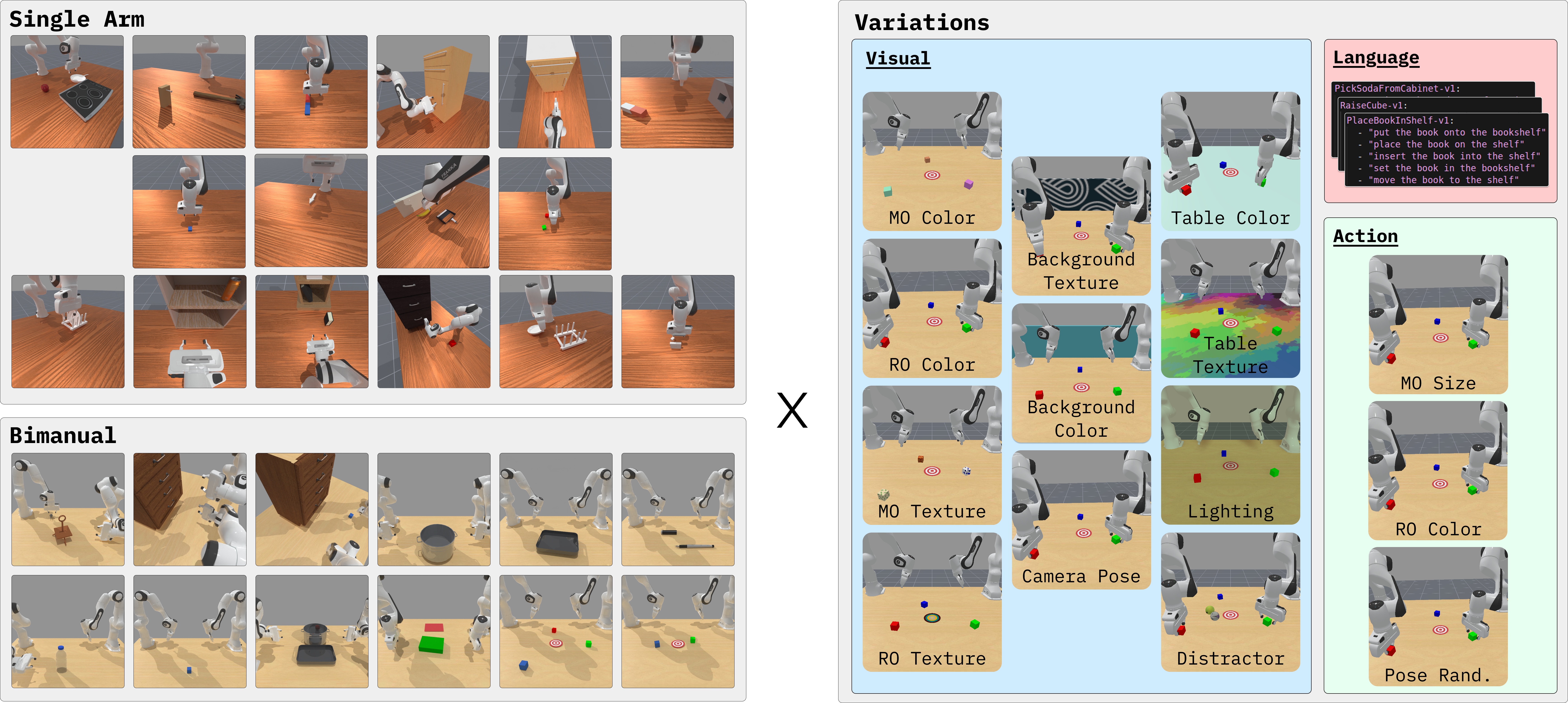
Overview of Colosseum V2 tasks and perturbations.

A large-scale, GPU-parallelized simulation benchmark for measuring how Vision-Language-Action policies generalize across visual changes, language rephrasings, action perturbations, and robot morphologies.

28

Manipulation Tasks

13

Task Categories

16

Perturbation Factors

2

Robot Morphologies

26x

Sim Steps / Sec compared to Colosseum

Abstract

Vision-Language-Action (VLA) models demonstrate promising generalization in robotic manipulation, driven by advances in large-scale vision and language pre-training. This progress can be misleading: despite strong zero-shot perception and language capabilities, task performance often degrades under distribution shifts, revealing gaps in how these systems translate high-level understanding into robust behavior.

We introduce Colosseum V2, a large-scale simulation benchmark for evaluating VLA generalization across diverse conditions. The benchmark comprises 28 tasks spanning 13 task categories and two robot morphologies, covering a wide range of manipulation primitives and long-horizon behaviors. Built on ManiSkill, Colosseum V2 enables fast, GPU-parallelized evaluation and supports both in-domain and out-of-domain testing at scale.

We evaluate state-of-the-art methods, including Action Chunking Transformers (ACT) and π0.5, and reveal limitations in both base performance and generalization. Hardware experiments show strong correlations between simulation and real-world metrics, supporting the benchmark's ecological validity.
Benchmark Design

Colosseum V2 evaluates generalization along visual, language, and action axes. It uses two Franka Panda setups: a single-arm manipulator with a parallel-jaw gripper and a bimanual configuration with two Panda arms operating in a shared workspace. Tasks are organized from simple manipulation primitives through temporally extended, long-horizon behaviors.

Single-Arm PJG

Sixteen tasks cover picking, pick-and-place, reorientation, insertion, tool use, articulated object interaction, and long-horizon manipulation.

RaiseCube PickSodaFromCabinet PickDishFromRack StackCube PlaceBookInShelf PlaceDishInRack LiftPegUpright RotateArrow PegInsertionSide PlugCharger HammerNail ScoopBanana OpenDrawer OpenCabinet PlaceCubeInDrawer CookItemInPan

Bimanual PJG

Twelve tasks test handovers, cooperative lifting, reorientation, insertion, articulated object interaction, and long-horizon dual-arm coordination.

DualArmCubeHandover DualArmBottleHandover DualArmLiftPot DualArmLiftTray DualArmPushBox DualArmPourPot DualArmThreading DualArmPenCap DualArmDrawerPlace DualArmDrawerOpen DualArmStackCube DualArmStackTwoCubes

Perturbation Axes

Visual

MO Color RO Color MO Texture RO Texture Table Color Light Color Table Texture Camera Pose Distractor Object Background Texture Background Color

Language

Language

Action

MO Size RO Size Pose Randomization

Combined

All Perturbations

Evaluation Protocol

The benchmark provides initial evaluations of two language-conditioned imitation learning models: ACT and π0.5. Models are trained separately for the single-arm and bimanual test suites using 100 perturbation-free demonstrations per task, then evaluated on each perturbation individually over 200 episodes.

GPU-parallelized simulation makes the evaluation statistically thorough without making it prohibitively slow. On a single RTX 4090, ACT can be evaluated on both test suites in 11.5 hours while producing ten times as many success-rate measurements as the original Colosseum evaluation setup.

Results and Analysis

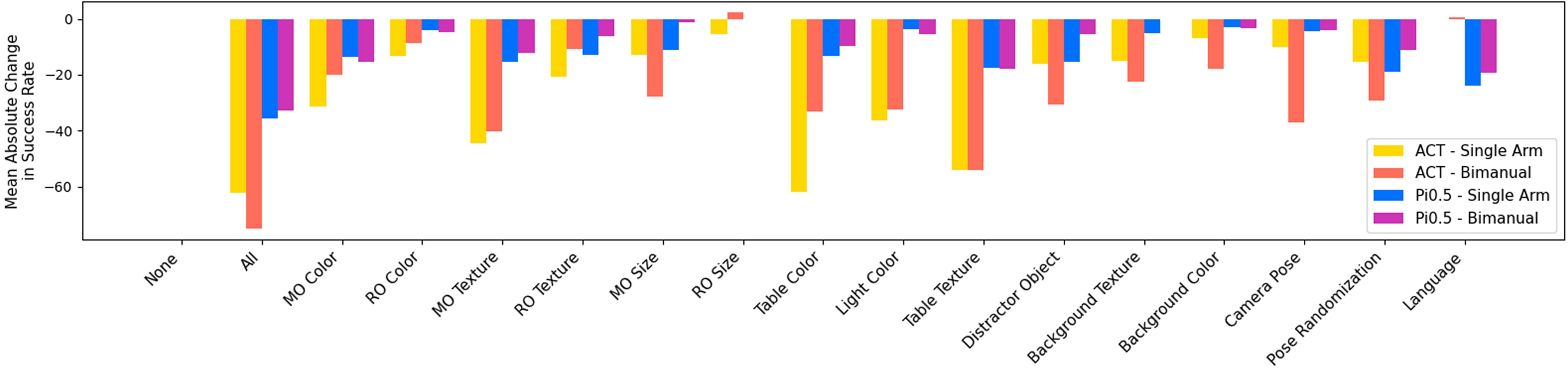
Average change in success rate for each perturbation.
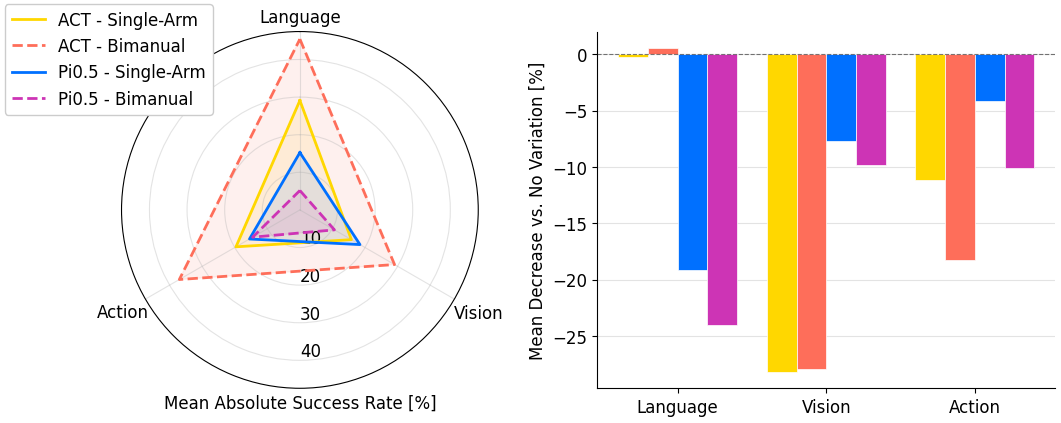
Overall generalization results across vision, language, and action perturbations.

Visual Generalization

ACT shows larger average success-rate drops under visual perturbations than π0.5: 28.57% and 29.06% on the single-arm and bimanual suites, compared with 7.73% and 9.86% for π0.5. The paper hypothesizes that π0.5 benefits from larger pretrained visual representations.

Language Generalization

ACT is nearly invariant to language rephrasings, with average drops of 0.28% and -0.57%. π0.5 drops 19.16% and 24.0%, suggesting that fine-tuning the whole model can reduce robustness to semantically equivalent instructions.

Action Generalization

Pose randomization is a primary challenge for both model families, especially in bimanual tasks where the action space and coordination demands are larger.

Base Success Rates

ACT achieves higher perturbation-free success rates than π0.5 on both suites, suggesting a tradeoff between task-specific proficiency and broader robustness.

Across morphologies, perturbations have remarkably consistent effects. The average change in mean absolute success-rate drop between single-arm and bimanual suites is 10.83% for ACT and 3.69% for π0.5, indicating that perturbation factors expose model-specific generalization behavior rather than only task-specific artifacts.

Hardware Validation

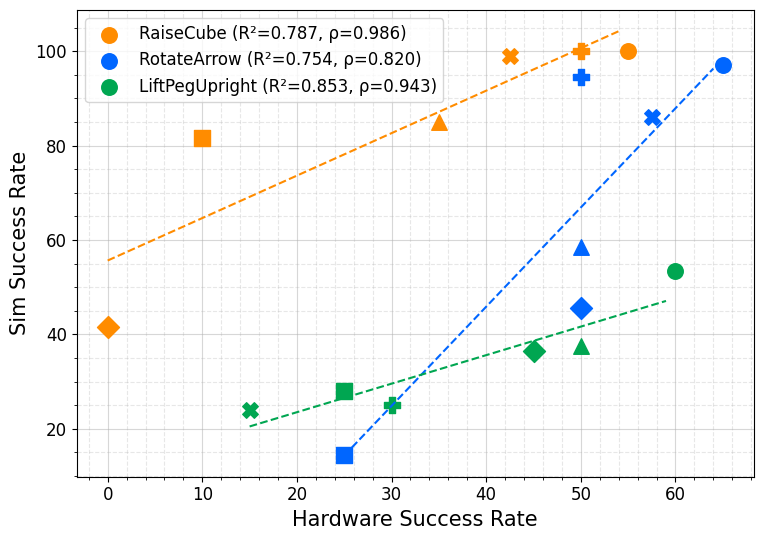
Simulation versus hardware success rate comparison.

Markers denote perturbations: • (None), ◆ (MO Color), ■ (Light Color), ▲ (Distractor Object), + (Background Color), and rotated + (MO Size).

To assess sim-to-real transfer, the benchmark recreates three single-arm tasks on real hardware: RaiseCube, RotateArrow, and LiftPegUpright. A multi-task ACT policy is trained from scratch with 60 demonstrations per task and evaluated under no perturbation, manipulation-object size, manipulation-object color, background color, and lighting changes.

Simulation does not perfectly predict absolute hardware success rates, but it strongly predicts relative degradation under perturbations. The average R-squared for predicting success-rate change is 0.798, and the average Spearman correlation is 0.916, indicating that the ordering of perturbation difficulty is largely preserved between simulation and hardware.

Appendix

If your browser does not display PDFs inline, open the appendix PDF directly.

BibTeX

@misc{morgan2026colosseumv2benchmarkinggeneralization,
      title={Colosseum V2: Benchmarking Generalization for Vision Language Action Models}, 
      author={Jeremy Morgan and Prajwal Vijay and Hyeonho Oh and Jincen Song and Ashvin Arora and Alina Du and Gaurav Sukhatme and Jesse Thomason and Ishika Singh},
      year={2026},
      eprint={2605.27759},
      archivePrefix={arXiv},
      primaryClass={cs.RO},
      url={https://arxiv.org/abs/2605.27759}, 
}